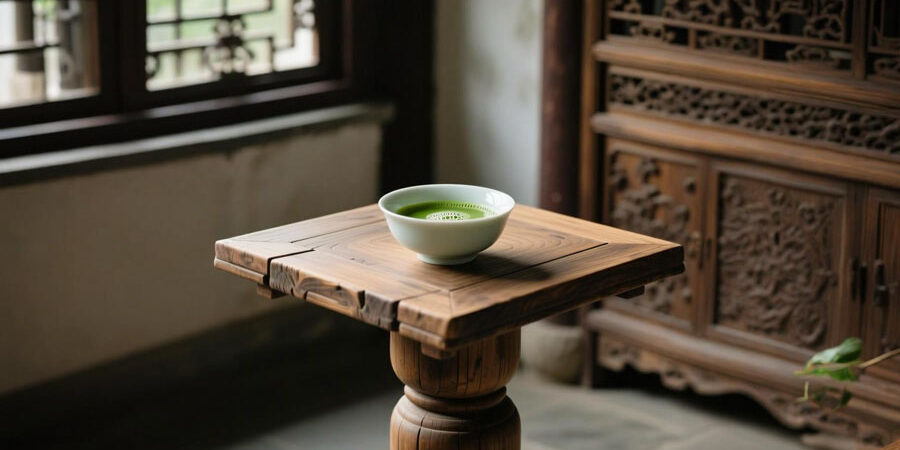
Matcha, the vibrant green tea powder, is not only a beloved treat for global food enthusiasts but also carries rich historical and cultural value. Its origins can be traced back to ancient China and, after its introduction to Japan, underwent unique transformations, ultimately becoming a symbol that transcends cultures.
Origin: The powdered tea of the Tang Dynasty
The history of matcha dates back to China’s Jin Dynasty (266–420 CE), when people began pounding tea into powder and boiling it. As society progressed and tea-processing techniques improved, during the Tang Dynasty (618–907 CE), , in the process of preparing and drinking matcha among emperors, nobles, and monks, it gradually developed into a refined art form.
According to Lu Yu, the renowned Chinese poet of the time, in his work The Classic of Tea (760 CE), matcha preparation involved seven steps, while tea consumption had nine specific rituals. This was not merely an act of enjoying tea but also a way to demonstrate one’s cultural refinement and social status. Notably, imperial matcha was extremely expensive, equivalent to about $10,000 per kilogram in modern terms.
During the Song Dynasty (960–1279 CE), matcha reached its peak. While tea drinking during the Tang Dynasty focused on technique, it became more about artistic expression in the Song period. Emperor Huizong of Song was an avid tea enthusiast and even wrote a treatise on tea. During this time, matcha ceremonies became more elaborate, requiring special tools like bamboo whisks and ceramic bowls.
Decline: From Ming Dynasty to Modern Times
By the Ming Dynasty (1368–1644 CE), societal changes and shifts in tea-processing methods led to the decline of powdered tea in China. The production of compressed tea cakes from the Tang era and intricately carved tea bricks from the Song era were replaced by loose, stir-fried teas in long, twisted strands. By modern times, China had developed a new mainstream tea culture comprising black tea, green tea, oolong tea, pu-erh tea, white tea, and yellow tea.
This shift marked the end of powdered tea’s dominance in China. Only a handful of tea connoisseurs continued to practice the art of matcha.
Introduction to Japan: From Religious Exchange to Cultural Integration
How did matcha make its way to Japan? Historical records indicate that it was first brought to Japan in the 9th century by Chinese Buddhist monks. However, matcha did not immediately gain popularity in Japan and only began to spread during the Kamakura period (1185–1333 CE).
In the 11th century, Chinese monks such as Rongxi and Nanpu brought the latest matcha making and drinking methods from the Song Dynasty to Japan, thus promoting the development of matcha in Japan. Over time, matcha gradually became an important part of Japanese culture, especially during the Edo period (1603-1868) after the rise of the samurai class.
Adaptation and Proliferation: Matcha’s Unique Path in Japan
Unlike China, which was a wealthy centralized empire, Japan faced unique challenges as a resource-scarce nation ruled by warriors (the samurai class). Starting during the shogunate era, Japan adapted matcha to fit its own cultural and practical needs.
Simplifications were made to matcha preparation methods, reducing complexity and lowering costs. The final product was refined further—its taste became sweeter, its bitterness reduced, and its flavor more delicate. This transformed Japanese matcha into a tea that was easier for the civilians to enjoy and promote.
Inheritance and Development: Modern Matcha Culture
During the 1980s, Japan began marketing matcha internationally, spurring global interest in this unique tea culture. Today, matcha has become a symbol of tradition combined with innovation. From the drinks of Chinese emperors to Japanese street snacks like matcha-flavored desserts,even the globally popular matcha milk tea, matcha’s cultural significance has transcended borders and time.
It is not just a drink but a testament to the fusion of cultures and the evolution of history. This cross-cultural transformation has allowed matcha to thrive on a global scale and serve as a bridge connecting East and West.
Matcha Videos
This small Chinese town is exporting matcha to JAPAN??
https://www.youtube.com/watch?v=5idl7YAItM0
David in Rural China: I drink a cup of matcha loved by 40 countries
https://www.youtube.com/watch?v=C6fRHMgQ6gs
Matcha Supplier
Sip of matcha, Sip of health Embrace a simple lifestyle
https://www.bemytea.com.hk/